
The following day the “Permit to Test” arrived via email from the LAA.
The wind abated by the evening, and it was from a northerly direction, ideal for runway 36 at Sleap.
In preparation for the test flying I had spent several hours sitting in the cockpit, developing a checklist and becoming familiar with the Garmin G3X Touch.
We decided to fly the first few flights with the wheel spats (pants) off. This was so we could keep an eye on the 6.00x6” wheels and brakes.
Yes, it was a big event … during the last 4 years 9 months of planning & building there had been lots of dreaming of this moment!
But once strapped in it was important to concentrate on the flying, and put into action the carefully planned flight profile.
The new engine required time running at high power, to prevent glazing of the cylinders during the critical first few hours of operation. But of course G-STRV, and Steve Hicks, would have quite liked a more gentle introduction! Of course there has to be a compromise, and it was decided to fly for about 15 mins, climbing out at 2500 RPM / 25 ins.
We had decided not to check the max static RPM before the first flight, thinking it full of jeopardy having to tie the plane down etc. So to avoid workload on the first take off, I planned to manually wind the Prop RPM back a small amount prior to applying power in case the governor was not set perfectly.
I also made sure all the traffic/terrain/AOA G3X alerts were deactivated to avoid distracting headset noise!
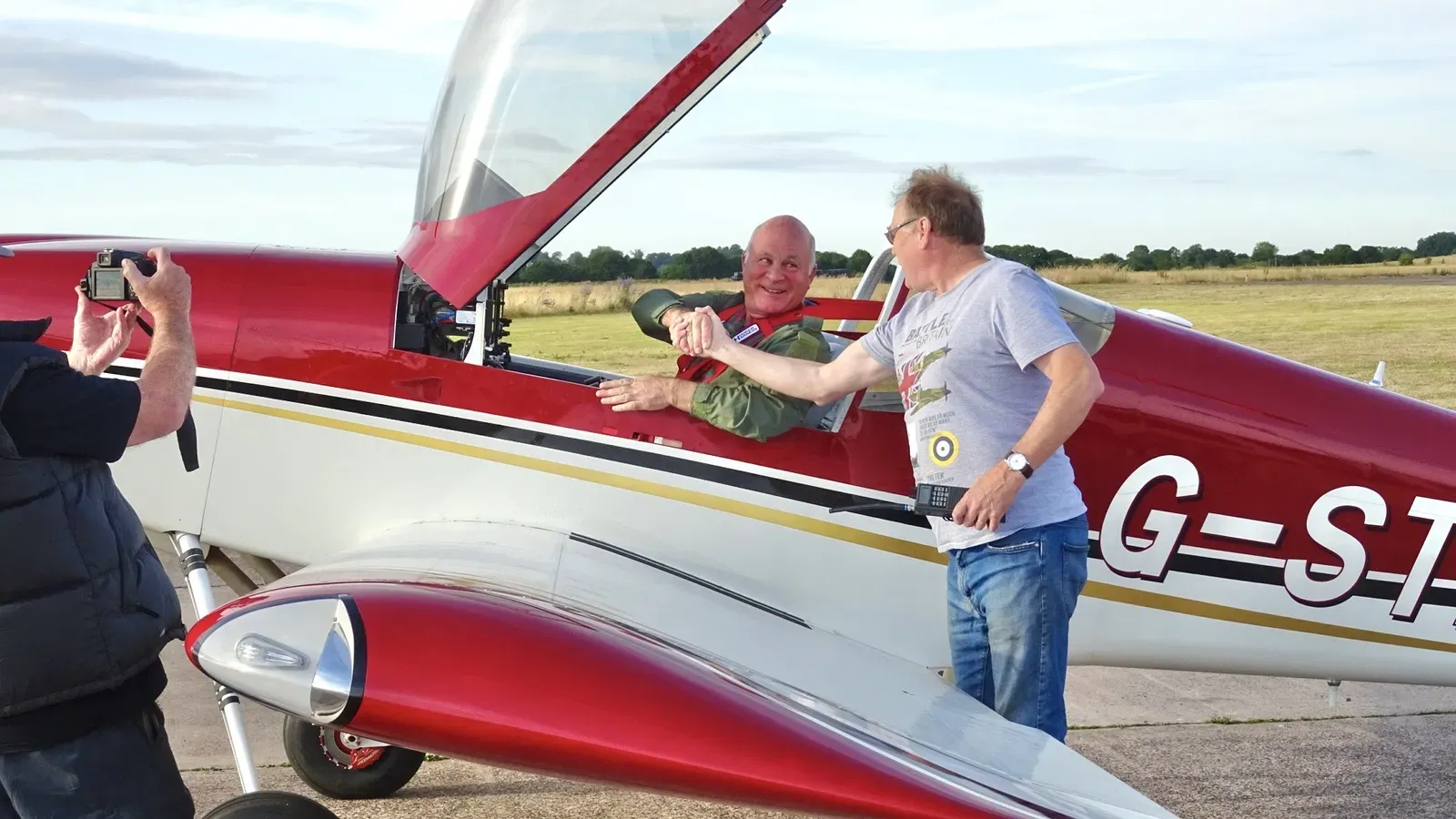
Having said cheerio to Tim, I taxied out and completed the engine run up.
The aeroplane felt right from the first moment I applied power.
I’d like to say the take off was uneventful … but just as I got airborne the canopy unlocked caption and warning triggered, giving me a fright. A quick confirmation of the canopy latch being locked told me it was the microswitch, so panic over!
In preparation for the first approach and landing I checked the low speed handling, but fairly nose high so I could avoid too low a power setting for the new engine.
I’d planned a wheeler landing, but in hindsight it would have been better to have done a three point. The wheeler needed precise handling to prevent G-STRV porpoising.
Subsequent landings have shown a three point in the correct attitude is more user friendly.
After landing I taxied G-STRV just off the runway and shut down … and savoured the moment : )
The hangar was at the other end of the airfield, so we towed her back, avoiding running the new engine at low power during this early stage of operation.
G-STRV flew beautifully, being rock stable with vibrant controls. Vans have done a first rate job with this design.
For those reading this still building away, keep going! Your RV14 is a great aeroplane.
A special moment : )
The LAA in the UK insist the first flight is carried out solo, but from now on Tim will be flying with me as we carry out the flight testing.